

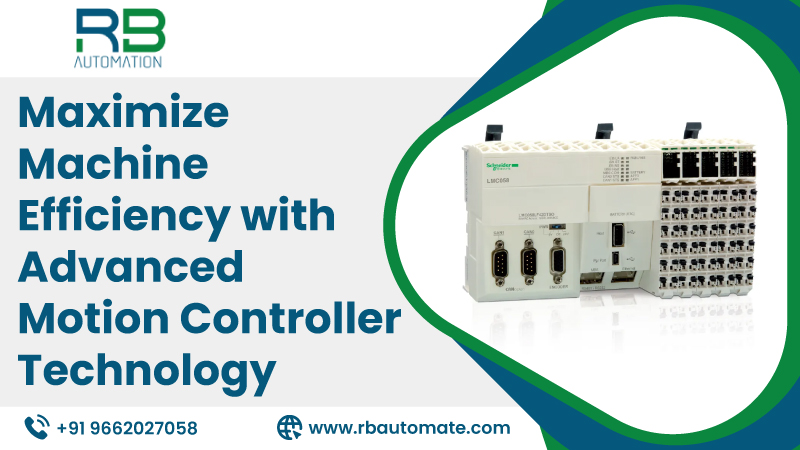
Modern manufacturing and automation demand precision, speed, and reliability. Selecting the right motion controller and integrating it properly into your system can dramatically improve throughout, reduce waste, and prolong machine life.
Understanding motion control and its impact
At its core, a motion controller translates production intent into coordinated motor motion. It receives commands from a PLC or higher-level system, executes motion trajectories, and coordinates multiple axes to meet timing and positional targets. Good motion control reduces cycle time, minimizes mechanical stresses, and improves product consistency. For many modern applications, integrating a high-quality motion controller is the difference between manual tweaking and automated precision.
RBA OPTISYNC PRIVATE LIMITED recommends thinking of motion control not as a single product but as a system: controller, drives, feedback devices, and motors all work together. Selecting the right components from trusted motion control systems suppliers helps prevent mismatches that can degrade performance.
Why advanced controllers matter for efficiency
Advanced controllers offer features that directly translate into measurable gains:
- Precise trajectory generation that reduces overshoot and vibration.
- Synchronized multi-axis control for complex motion patterns.
- Adaptive tuning and feedforward algorithms that keep accuracy under load.
- High-speed networking for deterministic communication across the cell.
A servo motion controller specifically targets systems that require tight position and velocity regulation. When paired with high-performance motors and drives, a servo motion controller can shorten cycle times while maintaining or improving accuracy — a vital combination for high-mix, high-volume production.
Matching controllers to motors: servo and stepper motor choices
Two common motor families appear in automated systems: servo motors and stepper motors. A well-specified motion platform often uses servo and stepper motor options depending on load, speed, and precision requirements.
Servo motors are suited for high-speed, high-precision tasks where closed-loop feedback supports dynamic performance. Stepper motors are an effective choice for simple positioning where cost-efficiency and predictable step increments matter. A modern servo motion controller can manage both types in mixed systems, making hybrid solutions practical.
When sourcing hardware, consult reputable motion controller’s suppliers to match motor torque curves and encoder resolution to your application. Local sourcing from motion controller suppliers in Gujarat or national partners like motion controllers’ suppliers in India reduces lead times and eases technical support.
Application-driven selection: pick what fits your process
Every application has unique priorities. Follow this practical, step-by-step approach to choose the right motion control components:
- Define performance goals: required accuracy, maximum speed, and acceptable cycle times.
- Quantify loads: calculate torque, inertia, and friction across operational envelopes.
- Decide feedback needs: incremental versus absolute encoders and required resolution.
- Choose motor type: select between servo and stepper motor options based on dynamic requirements.
- Pick the controller: evaluate motion controller features, supported axes, and built-in trajectory profiles.
- Confirm drive compatibility: ensure drive current and voltage match motor specifications.
- Plan safety and braking: select units with safe stop, torque off, or brake interfaces as needed.
- Source locally when possible: contact motion control systems suppliers or motion controllers’ suppliers in gujarat for on-site assistance.
Applying this method reduces guesswork and leads to a system where each element complements the others.
Design considerations that improve uptime and throughput
Machine efficiency is measured by uptime and output quality. Thoughtful motion controller deployment contributes to both:
- Minimize mechanical resonance by matching controller filters to the system’s natural frequencies.
- Use feedforward control to anticipate load changes and reduce settling time.
- Implement coordinated multi-axis moves to decrease index times and improve rhythm.
- Monitor runtime diagnostics from the controller for predictive maintenance and quick troubleshooting.
RBA OPTISYNC PRIVATE LIMITED recommends using controllers from trusted motion control systems suppliers that expose diagnostic telemetry. Early detection of encoder drift, drive overheating, or unexpected current spikes helps avoid unscheduled downtime.
Integration best practices and commissioning tips
Integrating a motion system requires careful planning. Follow these guidelines for smoother commissioning:
- Standardize on naming, scaling, and units across PLCs and controllers.
- Validate encoder wiring and shielding to eliminate electrical noise that can corrupt feedback.
- Tune under representative loads. Static tuning in an unloaded state gives a misleading impression of performance.
- Document all parameter changes and create rollback snapshots for safe experimentation.
Working with experienced motion controllers’ suppliers or local motion controllers’ suppliers in India can reduce commissioning time. RBA OPTISYNC PRIVATE LIMITED often supports customers through on-site tuning and long-term support contracts.
Selecting the right supplier: key factors to consider
Selecting a partner is as important as selecting hardware. Reliable motion control systems suppliers provide not only products but also application engineering, training, and spare parts. Prioritize suppliers who offer:
- Clear technical documentation and application notes.
- Local or regional support for faster response.
- Proven experience across similar industries.
- Training and commissioning services.
RBA OPTISYNC PRIVATE LIMITED partners with select motion controllers’ suppliers to offer customers a single point of contact for design, procurement, and after-sales service. This approach reduces integration complexity and accelerates time to production.
Real-world examples: gains you can expect
Consider these practical improvements realized in typical projects:
- A packaging line reduced cycle time by 18% after moving from open-loop stepper control to a coordinated servo motion controller strategy.
- A CNC retrofit improved surface finish consistency by upgrading to higher-resolution encoders governed by a modern motion controller.
- A pick-and-place cell achieved smoother trajectory execution and less scrap by employing an ethernet stepper motor controller with real-time motion synchronization.
These examples illustrate how the right controller choice — backed by competent motion controllers’ suppliers in India or locally in Gujarat — yields measurable ROI.
Why Choose Us
RBA OPTISYNC PRIVATE LIMITED brings deep domain experience in motion automation and a commitment to practical solutions. Our engineering team collaborates to define exact performance targets, match motion controllers and drives to motor characteristics, and deliver turnkey systems that reduce commissioning time. We work with trusted motion control systems suppliers, source components locally through motion controllers’ suppliers in gujarat, and provide ongoing technical support across India. Choosing RBA OPTISYNC PRIVATE LIMITED means partnering with a team that prioritizes measurable results, transparent specifications, and responsive service to keep your machines operating at peak efficiency.
Conclusion
Advanced motion control technology transforms machines into efficient, predictable tools that deliver quality and speed. Selecting the right motion controller, coordinating servo and stepper motor choices, and working with experienced motion controllers’ suppliers reduce cycle time and minimizes maintenance. Consider network performance, safety features, and local support when evaluating options from motion control systems suppliers.
RBA OPTISYNC PRIVATE LIMITED offers practical engineering guidance and regional sourcing through motion controllers’ suppliers in India and motion controllers’ suppliers in Gujarat, helping you upgrade with confidence and maximize machine efficiency for long-term operational gains.
key takeaways
- A well-chosen motion controller directly improves accuracy, cycle time, and machine stability by coordinating motors, drives, and feedback devices with precision.
- Matching the controller to the correct servo or stepper motor is essential—servo systems excel in high-speed, high-accuracy tasks, while steppers suit simpler, cost-efficient positioning.
- Performance depends on the whole system: controller, drives, motors, and encoders must be selected together to avoid mismatches that reduce throughput and reliability.
- Advanced features like multi-axis synchronization, adaptive tuning, feedforward control, and high-speed networking significantly boost uptime and production efficiency.
- Working with experienced motion control systems suppliers — especially those offering local support, diagnostics, commissioning, and spare parts — cuts integration time and improves long-term machine performance.
For tailored help to Motion Controller Technology, contact RBA OPTISYNC PRIVATE LIMITED at +91 96620 27058 or email inquiry@rbautomate.com for expert guidance and quotes.