
Automation today feels fast. Sometimes overwhelming. Machines expected to move with precision, stop without hesitation, repeat the same motion thousands of times without complaint. And behind all that motion, there’s always a motor doing the heavy lifting. This is where the Integrated Servo Motor quietly changes the conversation. Not flashy. Not loud. Just smart engineering that makes automation simpler, cleaner, and far more cost-effective. If you’re planning new automation or upgrading an existing system, this technology deserves your attention.
At RBA OPTISYNC PRIVATE LIMITED, we work closely with manufacturers who want compact designs, faster commissioning, and reliable motion control without unnecessary complexity. Integrated servo motors answer all of that in one neat package. Built-in driver. Built-in encoder. Fewer cables. Fewer components. Fewer headaches.
What Makes an Integrated Servo Motor Different
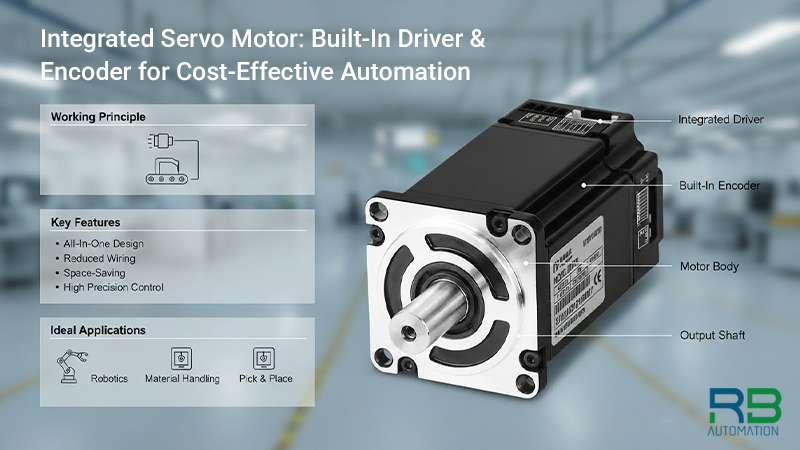
Traditional servo systems rely on separate components. A motor here. A drive there. Encoder wiring running between panels. It works, yes. But it also adds cost, space requirements, and installation effort. An integrated servo motor combines the motor, driver, and encoder into a single compact unit. Everything aligned. Everything matched.
This integration reduces wiring complexity and removes compatibility issues that often appear when mixing components from different vendors. The result is a motion system that feels cleaner and behaves more predictably in real applications.
Why Low-Voltage Matters in Modern Automation
Low-voltage automation is becoming the preferred choice across many industries. Safety regulations are tighter. Energy efficiency expectations are higher. Control systems are becoming more compact. That’s why the Integrated Low-Voltage Servo Motor stands out.
Operating at low voltage improves safety for operators and maintenance teams while still delivering accurate torque and speed control. It fits perfectly in machines where space is limited, and electrical safety is a top concern. For OEMs, this means easier compliance and simpler designs.
Built-In Driver and Encoder: Real Value, Not Just Features
Features only matter if they reduce real problems. A built-in driver means no external servo drive panel. That alone saves space and wiring time. A built-in encoder gives immediate feedback for precise positioning and speed control without alignment issues.
Together, they shorten installation time and reduce commissioning errors. The motor arrives ready to work. Configure. Power up. Run. This simplicity is exactly why many customers turn to RBA OPTISYNC PRIVATE LIMITED when designing new automation systems.
Cost-Effective Automation Without Compromise
Cost-effective doesn’t mean cheap. And it doesn’t mean cutting corners. It means making smarter design choices from the start.
That’s where integrated servo motors change the equation. By combining key components into a single unit, they reduce complexity across the system. Fewer cables to route. Smaller control panels to build. Less assembly labour on the shop floor. It all adds up. Quietly, but fast. Over the full lifecycle of a machine, those savings become hard to ignore. Installation is quicker. Maintenance is simpler. Troubleshooting takes less time. Stress drops.
An Integrated Low-Voltage Servo Motor still delivers the performance automation demands. Speed. Precision. Control. But without letting system costs spiral out of control. That balance matters—especially in competitive manufacturing environments where margins are tight and efficiency decides who stays ahead.
Compact Design That Fits Modern Machines
Machine designs are shrinking. Control cabinets are getting tighter. Integrated servo motors respond perfectly to this trend. Their compact footprint allows placement directly on the machine, closer to the load. Shorter cable runs improve signal quality and reduce electrical noise. This directly improves system stability. It’s a quiet advantage, but one that matters in precision automation.
Reliable Performance Across Applications
From packaging machines to material handling systems, integrated servo motors perform consistently across diverse applications. The built-in encoder maintains accurate feedback even during rapid acceleration and deceleration.
For applications requiring repeated positioning, this consistency protects product quality and reduces mechanical wear. It’s one reason Integrated Low-Voltage Servo Motor suppliers in India see growing demand across industries.
Simplified Maintenance and Troubleshooting
Maintenance teams love systems that just make sense. No puzzles. No unnecessary layers. That’s one of the quiet wins of integrated servo motors. Fewer components mean fewer failure points. There’s no separate drive wiring to double-check. No encoder cables running halfway across a control cabinet, waiting to cause trouble. When something does need attention, diagnostics are quicker. Faults are easier to isolate. Downtime shrinks. Sometimes a lot. And that alone makes a real difference on the floor. Shorter downtime improves overall equipment effectiveness—a metric every plant manager watches closely. Less stoppage. More uptime. Smoother operations. It’s not flashy. It’s just smart engineering doing its job.
Energy Efficiency and Thermal Management
Low-voltage servo motors naturally run cooler than their high-voltage counterparts. Less heat to begin with. And when the design is integrated, heat management gets even better. Optimized construction helps dissipate heat where it should, without stressing components.
That cooler operation improves long-term reliability. Electronics last longer. Motors stay healthier. Control panels don’t need aggressive cooling setups just to survive. Simpler cabinets. Fewer fans. Less noise.
Energy efficiency doesn’t always get applause on day one. It’s quiet. Almost invisible. But over time, it shows up exactly where it matters—operating costs. Lower energy use. Reduced cooling demand. Steady savings that keep adding up.
Designed for Smart Automation Systems
Integrated servo motors align naturally with modern automation architectures. They integrate easily with PLCs and motion controllers. Communication stays stable. Control remains responsive.
As automation systems become smarter and more connected, having compact, reliable motion components becomes a strategic advantage rather than just a technical choice.
Why Industries Prefer Integrated Solutions
Industries don’t chase technology because it looks good on paper. They choose it because it works. Day after day. Shift after shift. That’s why integrated servo motors keep gaining ground. They reduce system complexity while still delivering precise, dependable control. Fewer parts to manage. Fewer things to go wrong. Over time, that reliability builds trust. And trust matters more than trends ever will.
As automation demands grow and systems get tighter, this preference only gets stronger. It explains why Integrated Low-Voltage Servo Motor suppliers in India continue expanding their portfolios. More options. Better integration. Smarter designs. They’re responding to real industrial needs, not hype. And that’s exactly why this technology keeps moving forward.
Why Choose Us
Choosing RBA OPTISYNC PRIVATE LIMITED isn’t about ticking boxes on a datasheet. It’s about working with people who get how automation behaves on the shop floor. The team looks at how your machine runs in real life. Load changes. Space limits. Long shifts. Then they match the right integrated servo solution to that reality. Not oversizing. Not selling just to sell. Just what makes sense.
Years of hands-on experience across industries helps here. They know where performance really counts, where safety must stay rock solid, and where long-term value quietly saves money over time. Those trade-offs aren’t guessed. They’re understood. From selection to support, the involvement stays consistent. Questions get answered. Problems get solved. Systems stay stable. And your engineering decisions feel simpler, not heavier. That’s not just supply. That’s partnership.
Conclusion
Integrated servo motors with built-in drivers and encoders feel like a natural step forward in modern automation. Not flashy. Just smart. By pulling everything into one compact unit, they cut down system complexity right away. Fewer components. Less wiring. Faster installation. Lower costs before the machine even starts running.
The design stays clean and efficient. Low-voltage operation keeps things safer, while motion control remains precise and predictable. That balance is hard to ignore. Especially when space is tight and performance still matters. What really helps is the simplicity in machine design. Engineers don’t have to juggle multiple parts or overthink integration. The system just works. And it keeps working across different applications without drama.
For manufacturers and OEMs looking for automation that’s efficient, safe, and scalable, integrated servo motors make a lot of sense. They fit today’s industrial demands without overcomplicating tomorrow. And when backed by experienced partners, this technology becomes a solid foundation for cost-effective, future-ready automation systems.
Looking to simplify automation using integrated servo motors. Call +91 8511104864 or email contact@rbautomate.com to explore the right solution for your application.
Key Takeaways
- Integrated servo motors bring the motor, driver, and encoder together in one compact unit. Less juggling. More simplicity.
- Low-voltage operation improves safety and boosts overall system efficiency at the same time. A win on both sides.
- Fewer cables mean faster installation. And faster installation means lower total system cost. It adds up quickly.
- Built-in feedback keeps motion control precise and repeatable. No guessing. No drift over time.
- Perfect for modern automation systems where space is tight and performance still can’t be compromised.
FAQs
What is an Integrated Low-Voltage Servo Motor?
It’s a servo motor that brings the motor, drive, and encoder into one compact unit. Everything works together, right out of the box. And because it runs on low voltage, automation stays safer and easier to manage.
Where are integrated servo motors commonly used?
You’ll see them in packaging machines, conveyors, material handling systems, and other compact industrial equipment. Basically, anywhere space is limited, and clean motion control is needed.
How does integration reduce system cost?
Less hardware means less wiring. Smaller control panels. Faster installation. Maintenance also becomes simpler over time. All those small savings quietly turn into big ones.
Are integrated servo motors reliable for continuous operation?
Yes. With fewer connection points and a tightly integrated design, there’s less that can go wrong. That supports stable, long-term performance, even in demanding cycles.
Why choose Integrated Low-Voltage Servo Motor suppliers in India?
Local suppliers understand regional industry needs better. Support is faster. Communication is easier. And solutions tend to fit real applications, not just specifications.