


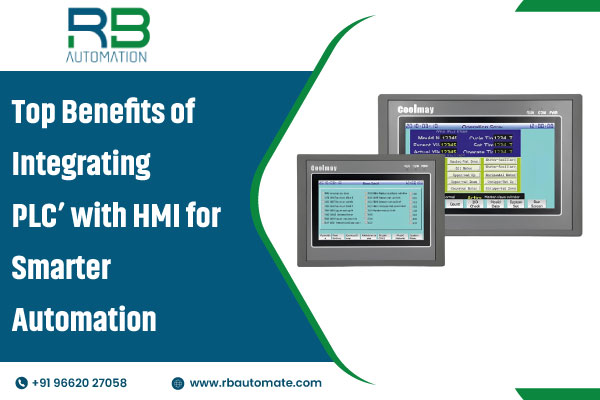
In today’s rapidly evolving industrial environment, automation isn’t just about replacing manual labor—it’s about enabling smarter, safer, and more efficient operations. One of the most powerful ways to achieve this is by integrating PLC HMI systems. At RBA OPTISYNC PRIVATE LIMITED, we specialize in designing and supplying top-tier PLC HMI Combo units that redefine how factories operate. In this article, we dive deep into why combining a programmable logic controller (PLC) with a human-machine interface (HMI) is a game-changer, especially for industries in India, and how working with leading PLC HMI Combo Suppliers in India (like us) can transform your automation strategy.
Modern industrial processes demand real-time monitoring, flexibility, and responsiveness. Traditional automation architectures often separate the control logic (handled by the PLC) from the operator interface (handled by the HMI), which can lead to complexity, higher costs, and slower response times. Integrating PLC HMI systems brings these components together into a unified architecture—giving operators a seamless way to control machinery while making the system more compact, intuitive, and cost-effective.
At RBA OPTISYNC PRIVATE LIMITED, we offer custom PLC HMI Combo solutions specifically designed for India’s industrial needs. As experienced PLC HMI Combo Suppliers in India, we help you reduce hardware footprint, simplify communication, and streamline maintenance. In this blog, we’ll unpack the key benefits, features, design considerations, and real-world impact of integrating PLC with HMI—and show you why this integration is critical to smarter automation.
Why PLC-HMI Integration Matters
What Is PLC and HMI?
A Programmable Logic Controller (PLC) is an industrial computer specially designed to control machinery, execute logic operations, and manage input/output (I/O) signals with high reliability. In contrast, a Human-Machine Interface (HMI) offers a graphical interface—usually a touchscreen—that allows operators to interact with the PLC-controlled system.
When combined, the PLC HMI Combo provides both logic control and a visual control panel in one integrated device, reducing complexity and improving system synergy.
Key Benefits of Integrating PLC with HMI
Enhanced Efficiency & Productivity
- Real-time data display: With a PLC HMI system, operators can see live process variables (temperature, pressure, speed) and react faster.
- Faster troubleshooting: Alarm management and diagnostics become more intuitive on HMI screens, allowing quick identification and resolution of issues.
- Reduced hardware: A PLC HMI Combo reduces the number of separate devices, saving panel space and cutting down installation time.
Better Operator Experience & Control
- Intuitive interface: HMIs present data graphically, with touch controls and dashboards that simplify operation for both new and experienced users.
- User-friendly design: Operators can modify parameters, monitor trends, and control processes without needing deep programming knowledge.
- Safety and alarms: HMIs can show alarms visually and audibly, making it easier to manage risks and respond promptly.
Cost Optimization
- Lower component cost: By combining PLC and HMI, you minimize the number of independent modules and associated cabling.
- Simplified maintenance: Fewer devices mean less maintenance overhead—monitoring and servicing become more efficient.
- Reduced engineering effort: Programming and debugging from a single platform (PLC + HMI) streamlines deployment.
Real-Time Monitoring & Diagnostics
- Live visualization: Operators can monitor process data in real time, helping in quick decision-making.
- Data logging: Integrated systems let you store historical data, assess trends, and generate reports.
- Predictive maintenance: Alerts and diagnostics help catch issues before they escalate, reducing downtime.
Streamlined Communication and Architecture
- Simplified wiring: A unified PLC HMI Combo reduces inter-device cabling complexity.
- Common protocols: Standard industrial protocols like Modbus TCP/IP, Ethernet/IP, or RS485 bridge PLC and HMI communication easily.
- Secure access: Role-based access control on HMIs helps restrict critical operations to authorized personnel.
Scalability & Flexibility
- Modular expansion: Many combo units support I/O expansion or communication module upgrades.
- Remote connectivity: Modern HMI/PLC units support remote monitoring, enabling oversight from anywhere.
- Industry 4.0 readiness: Integrated systems can feed data into IoT or SCADA platforms for analytics and centralized control.
Core Features of PLC-HMI Combo Units Offered by RBA OPTISYNC
When evaluating PLC HMI Combo Suppliers in India, certain technical features define quality and suitability for industrial tasks. Here’s what RBA OPTISYNC PRIVATE LIMITED offers in its combo units:
High-Resolution Touch Panels
- Available in various sizes (e.g., 4.5 inch , 7 inch) with vivid TFT displays.
- Responsive touch interface for easy navigation and control.
Powerful PLC Core
- Built-in PLC supports ladder logic, high-speed counters, and multiple I/O configurations.
- Memory capacity that supports complex industrial logic.
Security & Access Control
- Separate password protection for PLC and HMI layers (e.g., 8-digit password) to safeguard access.
- Encryption and user management features reduce risk of unauthorized alterations.
Connectivity Options
- Multiple communication interfaces: RS-232, Type-C for programming, RS-485 for field I/O, others as per need.
- Protocol compatibility: Modbus, Ethernet-based protocols, etc., for integration with broader systems.
Expandable & Modular Design
- I/O flexibility: Combo units can supportand analog I/Os as per customer requirements.
- Optional thermocouple inputs or specialty modules for temperature, analog, or high-speed control use cases.
Implementation Considerations for PLC-HMI Integration
While integrating PLC HMI systems provides immense value, the success of deployment depends on careful planning. Key considerations include:
Protocol Compatibility
Select communication protocols that both the PLC and HMI support. Common options include Modbus TCP/IP, Ethernet/IP, or RS-485.
Ensuring alignment avoids tag-mapping issues or data mismatches.
HMI Screen Design
- Design intuitive, clean HMI screens: use graphical elements, alarms, and trend charts for better usability.
- Test the UI thoroughly: simulate operator workflows to validate navigation, alarm flows, and data presentation.
Security and Access Management
- Define user roles and access levels to limit critical operations to authorized staff.
- Protect both PLC and HMI with passwords or encryption to prevent unauthorized tampering.
Testing & Commissioning
- Conduct rigorous testing before deployment—confirm that data exchange, I/O response, alarm conditions, and operator input all function correctly.
- Simulate real-world faults and error states to validate alarm handling and recovery.
Maintenance & Lifecycle Planning
- Use data logging and diagnostics to set up preventive maintenance schedules.
- Plan for future expansion: select combo units that support modular I/O or communication upgrades.
Real-World Applications of PLC-HMI Combo Systems
- Manufacturing & Machine Automation: In automated production lines, PLC HMI Combo units control and monitor assembly, conveyor, or robotic processes seamlessly. Operators can quickly intervene using touchscreen panels, reducing response time and improving throughput.
- Packaging & Material Handling: Combo systems coordinate packaging machines, fill lines, and palletizers. Operators interact with intuitive screens to monitor batch counts, control line speed, and manage alarms—all from a single interface.
- Water Treatment & Utilities: In water plants, PLC HMI integration helps manage pumps, valves, and chemical dosing. Real-time visualization through HMI aids operators in maintaining process stability, minimizing waste, and responding to fault conditions quickly.
- HVAC & Building Automation: Building management systems benefit from combo units controlling HVAC, lighting, and ventilation. The graphical HMI helps facility staff make quick adjustments and monitor energy consumption without needing separate control modules.
- Food & Beverage Industry: Combo units meet hygiene and compliance needs by offering reliable control and seamless operation. Operators can adjust process parameters, track production cycles, and manage alarms via a touchscreen, enhancing both efficiency and food safety.
Challenges & How to Mitigate Them
While PLC HMI integration is highly beneficial, there are some common challenges to anticipate:
Learning Curve
Operators may need training to use the HMI effectively.
Mitigation: Build intuitive UI designs, provide role-based screens, and deliver basic training at implementation.
Tag Mapping Errors
Incorrect mapping between PLC tags and HMI tags can lead to blank or wrong values on the screen.
Mitigation: During development, double-check tag mapping, simulate data flows, and validate in testing.
Protocol Incompatibility
Not all devices support the same protocols, leading to communication issues.
Mitigation: Choose combo units and field devices that support common protocols; plan architecture accordingly.
Single Point of Failure
If PLC and HMI are combined, failure in the device can bring down both control and monitoring.
Mitigation: Implement redundancy strategies or backup plans where needed, or choose combo units from reliable PLC HMI Combo Suppliers in India with strong quality and support.
Why Choose RBA OPTISYNC PRIVATE LIMITED
When you partner with RBA OPTISYNC PRIVATE LIMITED, you engage with a trusted provider of fully integrated PLC HMI combos. Based in Gujarat, we design solutions tailored to Indian industry needs and deliver them through our national network as recognized PLC HMI Combo Suppliers in India. Our team offers expert guidance—from system selection and customization to installation, commissioning, and after-sales support. With us, you gain not only device quality but also a partner committed to long-term reliability and performance.
Conclusion
Integrating PLC HMI systems represents a pivotal step toward smarter, more efficient automation. By merging the power of control logic with a rich, operator-friendly interface, PLC HMI combos simplify operations, reduce costs, and improve responsiveness across industrial processes. For businesses looking to build scalable, connected, and resilient automation infrastructure, working with a specialized provider like RBA OPTISYNC PRIVATE LIMITED ensures you unlock these benefits with precision, support, and long-term value.
Transform your automation with advanced PLC + HMI integration. Call us at +91 96620 27058 or email inquiry@rbautomate.com to discuss your requirements today.
FAQs
What exactly is a PLC HMI Combo?
A PLC HMI Combo is a single integrated device that combines a programmable logic controller (PLC) for automation logic with a human-machine interface (HMI) for operator visualization and control. By merging both units, it drives real-time decision-making and easier interaction.
How do PLC and HMI communicate in an integrated system?
PLC and HMI communicate via industrial-standard protocols like Modbus TCP/IP, Ethernet/IP, or RS-485. These protocols enable real-time data exchange, alarm signaling, and control commands between the PLC logic layer and the HMI screen.
What kinds of industries benefit most from PLC HMI integration?
Industries such as manufacturing, packaging, water treatment, HVAC, and food & beverage benefit significantly. In these environments, combo units offer streamlined control, reduced wiring, real-time monitoring, and intuitive operation.
Are these integrated units reliable for mission-critical operations?
Yes. High-quality PLC HMI Combo units are designed for industrial environments with rugged build, secure access control, and diagnostic capabilities. Plus, by working with top PLC HMI Combo Suppliers in India like RBA Optisync, you get strong technical support and design guidance.
How do I choose between separate PLC + HMI vs a PLC HMI Combo?
Consider factors like panel space, cost, wiring complexity, and future scalability. If you want reduced hardware count, easier maintenance, and unified programming, a PLC HMI Combo is often the smarter, more compact solution. However, if your system needs very high specialization, separate units might be preferred.