


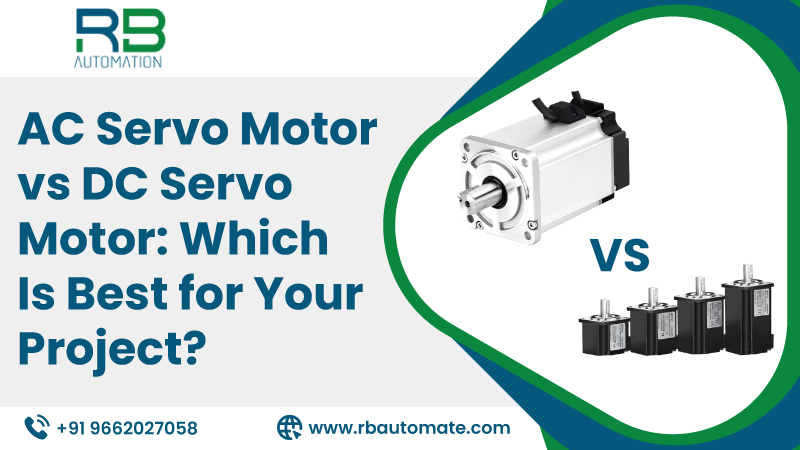
Choosing the right servo motor is a critical step in designing precise, reliable machinery. Whether you’re building industrial robots, packaging lines, CNC machines, or motion-control systems, understanding the differences between an AC servo motor and a DC servo motor helps you pick the technology that fits performance, cost, and maintenance needs. In this detailed guide, RBA OPTISYNC PRIVATE LIMITED walks you through real-world comparisons, practical selection tips, and product recommendations so you can decide with confidence.
What is a Servo Motor? A simple overview
A servo motor is an actuator that provides controlled rotational motion and position feedback. Compared to generic motors, servo systems couple a motor with a feedback device (encoder or resolver) and a drive/controller that precisely controls speed, torque, and position. Both AC servo motor and DC servo motor families use feedback for high accuracy, but they differ in construction, control electronics, and the kinds of applications where each excels.
Basic technical differences (clear and practical)
An AC servo motor typically uses alternating current and pairs with sophisticated digital drives. These motors are often brushless, use permanent magnets or synchronous designs, and rely on encoders/absolute sensors for feedback. A DC servo motor usually denotes a brushed or brushless motor powered by direct current; historically, brushed DC servo motors were simpler but required more maintenance because of brushes and commutators. Modern DC servo motor implementations are commonly brushless (BLDC) and are driven by controllers that emulate classic DC behavior while adding modern control features.
Key technical contrasts:
- Torque & speed behaviour: AC servo motor systems are engineered for higher continuous torque and better thermal performance in demanding industrial environments. DC servo motor systems excel in simpler applications where initial cost or compact size is a priority.
- Control complexity: AC servo motor drives often provide advanced algorithms (field-oriented control, torque control), while DC servo motor setups can be simpler to tune for basic tasks.
- Durability: Brushless AC servo motor and brushless DC servo motor designs remove brush wear, improving lifetime and reducing maintenance.
- Cost: For comparable performance, systems using AC servo motor drives may carry a premium but deliver long-term value in reliability and precision.
When to pick an AC servo motor
Choose an AC servo motor when your project requires:
- High precision positioning and repeatability under continuous operation.
- Strong continuous torque and better thermal handling for long duty cycles.
- Integration into modern automation systems that benefit from advanced drive features.
- Scalability for larger machines or where multiple axes need synchronized control.
If you are sourcing components, an experienced ac servo motor supplier can recommend the right motor torque curve, encoder resolution, and drive tuning. For those operating in or around Gujarat, checking with AC servo motor suppliers in the region can provide quicker access to products and technical support.helps shorten lead times and logistics. If your project needs motors with secure stopping capability, you may want to buy ac servo motor with brake to add safety and hold position under power loss.
When to pick a DC servo motor
A DC servo motor is a smart choice when:
- Simplicity and lower initial cost are primary constraints.
- The application involves short duty cycles, light loads, or compact installations.
- You want straightforward speed control and easier repairability in the field.
- Budget or space constraints Favor DC servo motor solutions.
To source components, consult a reliable DC servo motor supplier to match armature currents, gear options, and encoder choices. If your operation is near Gujarat, contacting DC servo motor suppliers in gujarat often helps with on-site support. For applications requiring braking, consider models where you can buy DC servo motor with brake.
Performance comparison: speed, torque, accuracy
- Speed response: Both motor types can be tuned for fast response, but AC servo motor systems generally provide better high-speed stability due to advanced control loops.
- Torque at low speed: AC servo motor tends to offer superior continuous torque at low RPMs versus equivalent DC servo motor units.
- Accuracy: With high-resolution encoders, both achieve sub-millimetre or sub-degree accuracy. The drive capability and tuning often determine final precision; modern AC servo motor controllers typically include more advanced tuning parameters.
- Heat and duty cycle: AC servo motor designs usually handle continuous duty and higher ambient temperatures better than traditional brushed DC servo motor designs.
Practical selection checklist (step-by-step, easy to use)
- Define motion goals: position resolution, repeatability, max speed, cycle rate.
- Calculate mechanical loads: torque, inertia, and safety margins.
- Decide on duty cycle: continuous or intermittent operation.
- Choose feedback level: encoder counts or absolute position.
- Match drive features: field-oriented control, network interfaces (EtherCAT, ProfNet), braking options.
- Evaluate environment: temperature, dust, humidity — this affects motor protection ratings.
- Compare total cost: motor + drive + maintenance over lifetime.
RBA OPTISYNC PRIVATE LIMITED recommends reviewing both motor and drive as a system — a mismatched drive can limit either an AC servo motor or a DC servo motor.
Brakes, safety, and holding torque
For applications that require holding position during power loss or emergency stops, look for models where you can buy ac servo motor with brake or buy DC servo motor with brake. Braked motors add mechanical holding force and are crucial for vertical axes, lifts, or safety-critical equipment.
Maintenance and lifecycle considerations
Brushless AC servo motor and modern brushless DC servo motor units reduce routine maintenance. However, drives and feedback devices still require periodic checks. Choose an ac servo motor supplier or DC servo motor supplier who can provide spare parts and calibration services. If your facility is near Gujarat, selecting ac servo motor suppliers in gujarat or DC servo motor suppliers in gujarat helps with faster service response.
Real-world examples: matching motors to projects
- CNC router or milling machine: prefer AC servo motor for stiffness, continuous torque, and tight position control.
- Conveyor with occasional indexing: a DC servo motor may be cost-effective and simpler to control.
- Robotic arms with multi-axis coordination: AC servo motor systems usually provide smoother interpolation and synchronous motion.
- Packaging machines with intermittent cycles: DC servo motor offerings can meet requirements while cutting costs.
RBA OPTISYNC PRIVATE LIMITED has helped customers choose both AC servo motor and DC servo motor based on these criteria, supplying tailored solutions for compact machines and large production lines alike.
Installation tips (practical, no-nonsense)
- Always match motor inertia to load inertia for stable control.
- Use shielded encoder cables and proper grounding to avoid noise.
- Size the drive for peak current, not just nominal load.
- If using brakes, wire in safety circuits per local regulations.
- Test tuning in safe, low-load conditions before full operation.
Why Choose Us
RBA OPTISYNC PRIVATE LIMITED delivers practical, application-driven motion solutions backed by experienced engineers and local support. We supply both AC servo motor and DC servo motor products, work closely to define exact performance needs, and recommend the best fit—whether you need to buy ac servo motor with brake or prefer compact DC servo motor systems.
Our regional presence helps customers source components quickly and access fast service from AC servo motor suppliers in Gujarat and DC servo motor suppliers in Gujarat offer faster availability, easier coordination, and locally accessible technical support. Choosing RBA OPTISYNC PRIVATE LIMITED means fewer integration risks, clearer specifications, and a partner who stands behind product performance across your machine lifecycle.
Conclusion
Selecting between an AC servo motor and a DC servo motor depends on your project priorities: precision, continuous duty, and advanced control tilt the decision toward AC servo motor, while smaller budgets, simpler tasks, and compact designs favor DC servo motor. Assess load, duty cycle, feedback needs, and integration complexity. Work with experienced suppliers to match motor, drive, and encoder as a system. RBA OPTISYNC PRIVATE LIMITED provides hands-on guidance and product choices to help you decide—whether you plan to buy ac servo motor with brake or buy DC servo motor with brake—so your machine delivers accurate, reliable motion for years.
Key takeaways
- Choose by duty and precision: pick an AC servo motor for continuous, high-precision, multi-axis or heavy-duty applications; choose a DC servo motor for simpler, intermittent or budget-sensitive tasks where compactness and lower upfront cost matter.
- Evaluate motor + drive as a system: match torque/inertia, encoder resolution, and drive features (field-oriented control, network interfaces) rather than selecting the motor alone—mismatched drives limit performance.
- Prioritise braking and safety where needed: specify motors with integrated brakes for vertical axes, lifts, or safety stops and wire brakes into the machine safety circuits per local rules.
- Factor lifecycle costs, not just price: favour brushless designs and reputable suppliers that offer spare parts, calibration, and local support to reduce maintenance and downtime over the lifetime of the machine.
- Use a clear selection checklist: define motion goals (resolution, speed, duty cycle), calculate loads and safety margins, choose feedback type, confirm environmental protection, and compare total cost (motor + drive + service) before final purchase.
Interested in AC Servo Motor vs DC Servo Motor: Which Is Best for Your Project?” Call us +91 96620 27058 or email inquiry@rbautomate.com for tailored advice and quotes today.